


Our team of engineers reviews your application and requirements, listen to your needs, and respond to offer a more innovative die cutting & converting solution to improve your current manufacturing process. Each machine is designed after a careful evaluation of the customer needs, the challenges of the material to be converted, therefore every machine produced is “made to order” for each client
Why Choose Us
R&D Capability
We have 33 engineers and 208+ patents. Our quality and sales are leading in China and we have exported to 10+ countries.
Advanced Equipment
Feixinda is guided by customer needs, providing customers with flexible material processing equipment such as precision die-cutting and precision mounting. Feixinda is committed to becoming an international leading intelligent equipment provider.
Innovation
Feixinda regularly organizes core R&D teams to study overseas, continues to form an exchange and cooperation model with German institutions, and maintains the backbone of R&D from the most cutting-edge innovative thinking input of international scientific research.
The continuous output of new products and the iterative improvement of new challenges to adapt to the drastic changes in market demand.
Professional Team
We are a national high-tech enterprise engaged in independent research and development, manufacturing and marketing.
The special team is divided by the core personnel of each project, which is a mature technology, efficient and innovative R&D team with higher education background and many years of practical experience.


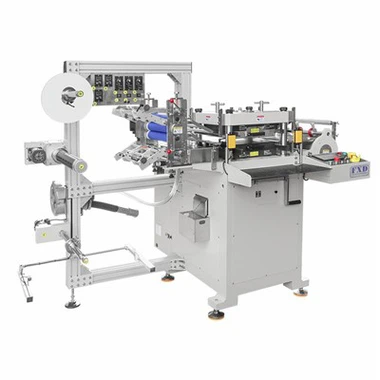


Benefits of Die Cutting Machine
Faster Productivity
A die cutting machine will allow you to produce identical shapes with just one punch. This means you can produce a number of beautiful products in a short time. This is true whether you use a manual or a digital die cutter for your business. The faster you can finish your products, the sooner you can provide them to your customers.
Less Wasted Material
Because die cutting is so precise, you'll waste a lot less material than you might when using other methods. This will help you create more shapes from your materials. Not only is less material waste good for the environment, but it's good for your bank account, too.
Complex And Unique Shapes
One of the standout benefits of die cutting machines is that they allow you to create complex shapes for your products. For instance, if you sell business cards, you don't need to stick to the typical rectangular-shaped cards. Instead, you can create heart-shaped cards, or a unique shape chosen by your customer, especially for their industry.
Various Cutting Capabilities Available
Die cutting machines come with various cutting and shaping capabilities, such as through cutting, perforating, kiss cutting, and scoring. The ability to cut and shape in various ways will help you create innovative, new products.

Choosing the Right Die Cutting Machine
Selecting the right die cutting machine depends on various factors, including the type of materials you need to cut, production volume, and budget. Here are a few tips to help you make the right choice:
Consider the types of materials you will be cutting. For example, if you need to cut thick materials like rubber or wood, an industrial die cutting machine might be the best option.
Evaluate your production volume. For high-volume production, an automatic die cutting machine would be ideal, while a digital die cutter might suffice for smaller, custom projects.
Think about the complexity of the cuts you need. If you need intricate and detailed cuts, a digital die cutter or computerized die cutting press would be suitable.
Assess your budget. While industrial die cutting machines offer robust capabilities, they may come with a higher price tag compared to other types.
Types of Die Cutting Machines
Automatic Die Cutting Machines
Automatic die cutting machines are designed for high-volume production environments. These machines can handle large batches with minimal human intervention, making them ideal for industries that require consistent, precise cuts. Key features include.
Digital Die Cutters
Digital die cutters are perfect for smaller-scale operations and custom projects. These machines use digital files to guide the cutting process, allowing for intricate and precise cuts without the need for physical dies.
Computerized Die Cutting Presses
Computerized die cutting presses combine the power of traditional die cutting with the precision of computer control. These machines are capable of handling heavy-duty materials and are often used in industrial applications.
Industrial Die Cutting Machines
Industrial die cutting machines are built for the most demanding applications. These machines are robust, reliable, and capable of handling high-volume production runs.
The Die Cutting Process Typically Involves the Following Steps
Design And Creation Of Die: A die is a specialized tool consisting of a sharp cutting edge or a series of cutting blades arranged in a pattern that matches the desired shape or design. The die is typically made of a hard and durable material, such as steel, and is custom-made for each specific cutting application.
Material Preparation: The material to be cut is prepared by either feeding it through a roll-to-roll system or placing individual sheets or pieces onto the die cutting machine. The material can be in various forms, such as sheets, rolls, or continuous web.
Loading The Die: The die is loaded onto the die cutting machine and securely fixed in place. The material to be cut is positioned on top of the die, ensuring that it aligns with the cutting pattern.
Cutting Process: The die cutting machine applies pressure to the material, forcing it against the sharp cutting edge of the die. This results in the material being cut into the desired shape or design as defined by the die. The cutting process can be done in a single pass or multiple passes, depending on the complexity of the design and the material's thickness.
Waste Removal: After the cutting process, the excess material or waste, known as "webbing" or "chads," is removed from the die-cut pieces. This can be done manually or through automated systems, such as vacuum or air blowers.
Collection And Inspection: The die-cut pieces are collected and inspected for quality control purposes. Any defective or damaged pieces are discarded, while the good pieces are ready for further processing or packaging.
Company Certificate


FAQ
As one of the leading die cutting machine manufacturers and suppliers in China, we warmly welcome you to buy die cutting machine made in China here from our factory. All machines are with high quality and competitive price. Contact us for quotation and free sample.
die cutter settings, die cutter device, die cutting capacity